Roof Rats vs Norway Rats: Which Rat Is in Your Durham Home?
Short answer: In Durham, the rat in your crawl space, garage or yard is almost certainly a Norway rat. Roof rats vs Norway rats comes down to body shape and behavior: roof rats are slender climbers with tails longer than their bodies that nest up high, while Norway rats are heavy, blunt-nosed burrowers that nest at ground level. North Carolina’s state mammal survey describes roof rats as rare and local across most of the state.
That matters because the two species get into houses in different ways. If someone tells you the noise in your Durham attic must be roof rats, it is worth understanding how to check for yourself.
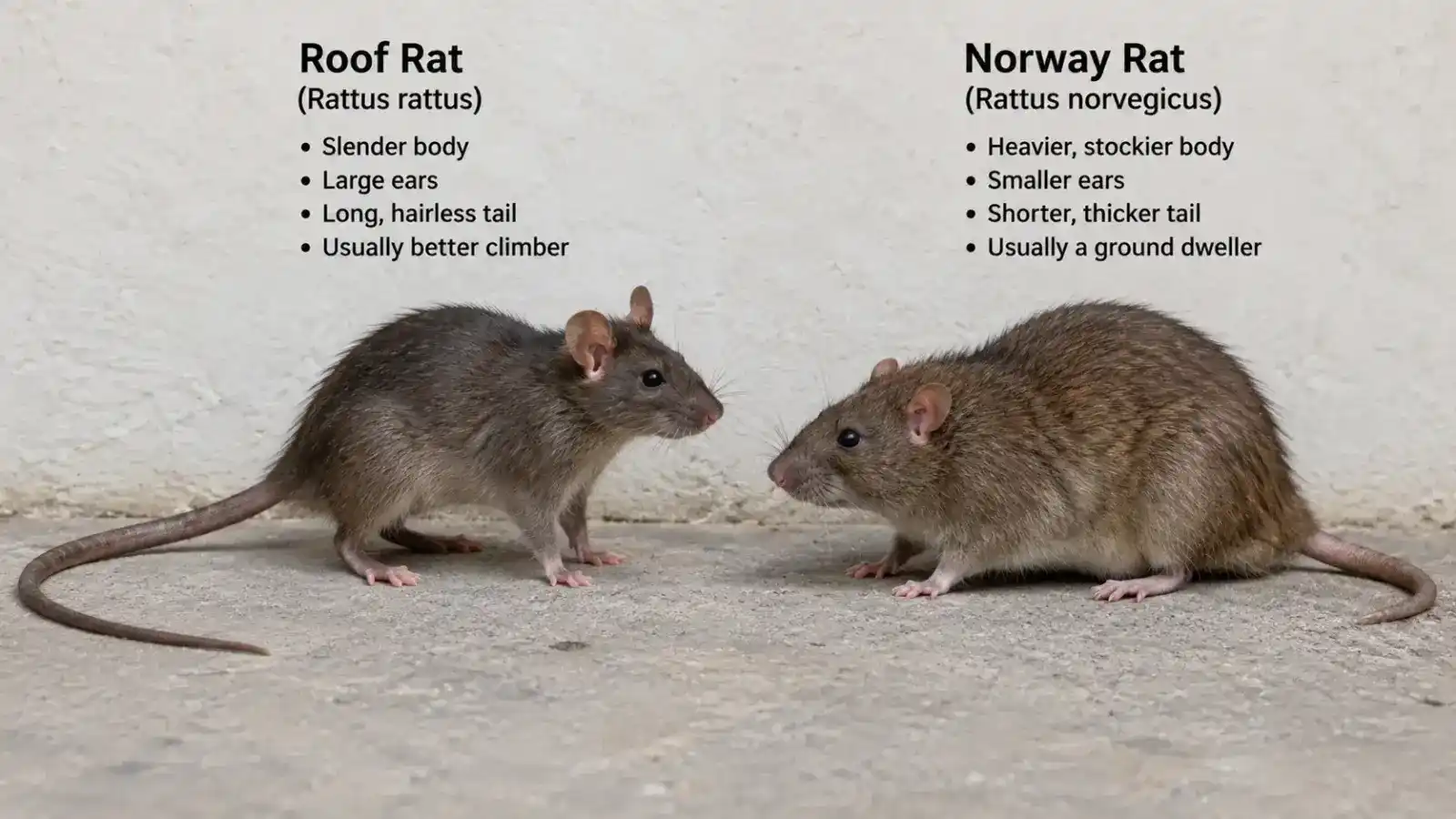
Roof Rats vs Norway Rats at a Glance
| Feature | Norway rat (Rattus norvegicus) | Roof rat (Rattus rattus) |
|---|---|---|
| Body | Heavy and stocky | Slender and sleek |
| Total length | About 12 to 18 inches with tail | About 13 to 17 inches with tail |
| Tail | Shorter than head and body, thick, scaly | Longer than head and body, thin |
| Nose and ears | Blunt nose, small close-set ears | Pointed nose, large thin ears |
| Fur | Brown to gray-brown, lighter belly | Black to gray-brown, often with a lighter or gray belly |
| Droppings | About 3/4 inch, capsule-shaped, blunt ends | About 1/2 inch, spindle-shaped, pointed ends |
| Nests | Burrows in soil, crawl spaces, basements, under slabs | Attics, rafters, trees, vines and dense shrubs |
| In North Carolina | Common statewide, especially around people | Rare and local across most of the state |
Which Rat Is Common in Durham?
The Norway rat, also called the brown rat, is by far the most common rat in Durham and across most of North Carolina. It thrives anywhere people live: along creeks like Ellerbe Creek and Third Fork Creek, around restaurant dumpsters downtown, in crawl spaces under older houses, and in barns in the northern part of the county.
The roof rat, also known as the black rat or ship rat, arrived in North America on ships and does well mainly in warm coastal areas. North Carolina’s state mammal survey describes it as rare and local across most of the state, with records scattered and poorly documented, and notes it has largely been displaced by the brown rat (NC Mammal Survey). Older studies found it mainly around port cities such as Wilmington.
That does not make roof rats impossible in the Piedmont. It means that when you hear a rat in Durham, the odds strongly favor the Norway rat, and the burden of proof is on anyone claiming otherwise.
“But the Noise Is in My Attic”: Can Norway Rats Climb?
Yes. This is the source of most confusion. Norway rats are ground-dwellers by preference, but they are capable climbers. They can go up rough brick and block walls, downspouts, utility lines, pipes inside wall cavities and trees with branches touching the roof. In a Durham house with a crawl space, a Norway rat can live under the floor and travel up through plumbing chases and interior walls into the attic at night.
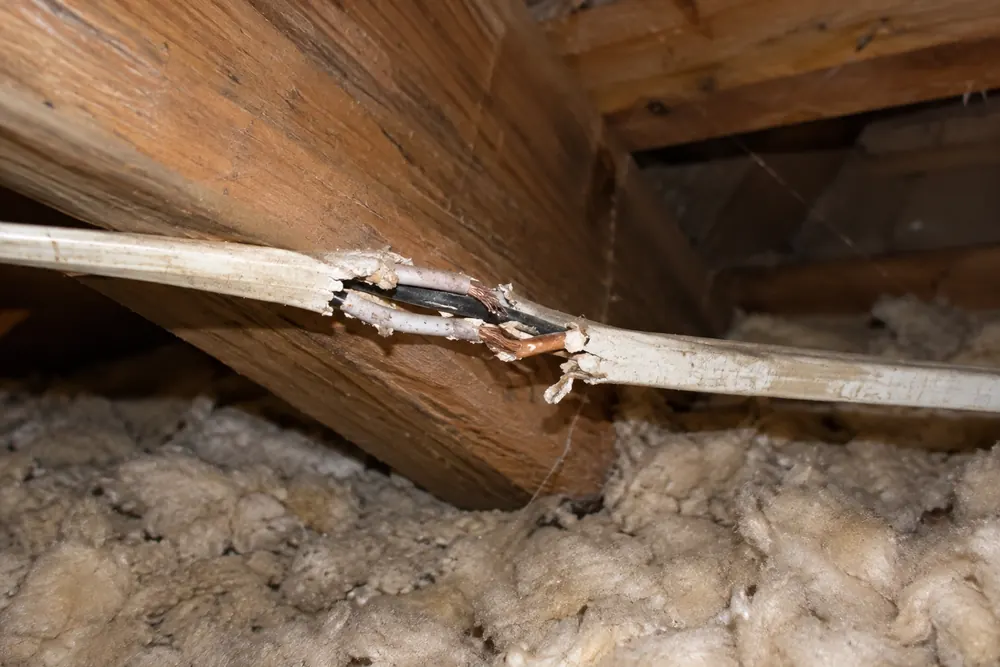
So noises overhead do not automatically mean roof rats. Other attic suspects include house mice, which climb very well and are far more common in Durham attics than any rat, and squirrels, which are active during the day rather than at night.
How to Tell Which Rat You Have Without Seeing It
Most people never get a good look at the animal. These clues help identify it anyway.
1. Check the droppings
Norway rat droppings are thick, roughly three-quarters of an inch long, with blunt ends. Roof rat droppings are smaller, about half an inch, and pointed at the ends like a spindle. Mouse droppings are much smaller, around a quarter inch.
2. Look for burrows
Burrows around the foundation, under the HVAC pad, beneath decks and sheds, or along a slope in the yard are a strong sign of Norway rats. Roof rats rarely burrow.
3. Notice where the activity starts
Norway rat problems usually start low: crawl space, garage, basement, the base of exterior walls. Roof rat activity typically starts high: in the attic, along the roofline, in trees and dense vines like ivy or climbing jasmine.
4. Look at the travel routes
Norway rats leave greasy rub marks along walls and joists at ground level and in crawl spaces. Roof rats leave rub marks along rafters, beams and the tops of walls, and they often run along utility lines between poles and houses.
5. Check what is being eaten
Norway rats eat almost anything, including garbage, pet food and meat scraps. Roof rats tend to prefer fruit, nuts, seeds and vegetation, so damage to fruit trees or stored nuts can point their way.
6. Look at the tail, if you can
If you do see one or catch one, the tail is the quickest giveaway. A tail longer than the head and body together points to a roof rat. A shorter, thicker tail points to a Norway rat.
7. Consider the location
A house in Durham, Chapel Hill or Hillsborough is far more likely to have Norway rats. In a coastal port city, the odds shift.
Why the Species Matters for Fixing the Problem
Identifying roof rats vs Norway rats correctly changes where a provider looks, where traps go and which openings get sealed first.
- Norway rats: the focus is the foundation, crawl space vents, access doors, sill gaps, utility penetrations and burrows. Hardware cloth skirts may be needed where rats tunnel under slabs, sheds or decks. Traps go along ground-level runways.
- Roof rats: the focus shifts upward: roof returns, soffits, gable vents, tree limbs and vines touching the house, and utility line entry points. Traps go in the attic and along elevated travel routes.
Treating a Norway rat problem as a roof rat problem can mean money spent sealing the roofline while the rats keep walking in through a broken crawl space vent. For how the work is done here, see our page on rat removal in Durham.
Where Durham Rats Usually Turn Up
Rat problems in Durham tend to show up in the same kinds of places, and almost all of them fit Norway rat behavior rather than roof rat behavior.
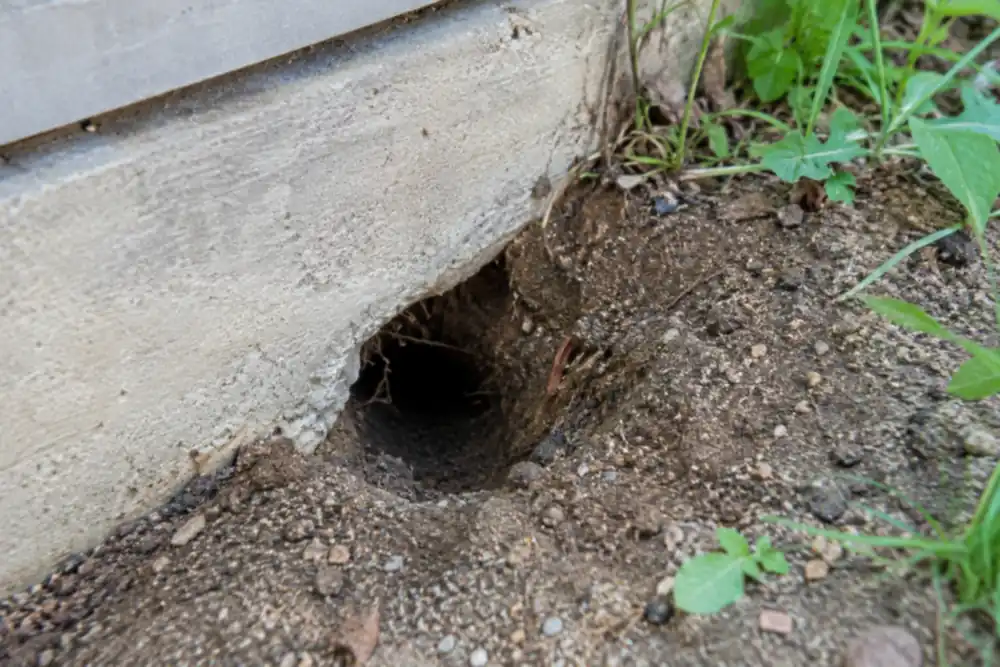
- Creek corridors. Homes backing onto Ellerbe Creek in Northgate Park and Old North Durham, Third Fork Creek near Forest Hills and Hope Valley, and smaller drainage creeks across South Durham see rats burrowing into banks and moving into yards at night.
- Older crawl space houses. Mill houses and bungalows in Old West Durham, Walltown and East Durham, with rusted vent screens and settled sills, give rats direct access under the floor.
- Downtown and restaurant blocks. Dumpster pads and grease bins behind restaurants on Main Street, Ninth Street and around Brightleaf support rats that then explore nearby buildings.
- Construction edges. Land clearing for new apartments and subdivisions displaces rats into the nearest homes and businesses.
- Barns and feed rooms. In Bahama, Rougemont and other rural parts of the county, rats live around livestock feed and hay and move toward houses in fall.
None of these settings call for an attic-first roof rat approach. They call for ground-level inspection, burrow treatment and sealing of the foundation, which is what most rodent control in Durham comes down to.
Native Rats That Are Not the Problem
Two native species sometimes cause confusion in the Durham area:
- Hispid cotton rat: a coarse-furred rat of fields, roadsides and overgrown lots. It lives outdoors and rarely enters houses, though it may show up in sheds or barns near fields.
- Eastern woodrat: also called the packrat, it lives in forests and rocky areas, has a furry tail and large eyes, and is uncommon around homes.
Neither species is a typical cause of indoor rodent problems. If a rat is living in or under your house, it is almost certainly a Norway rat, with house mice the likely culprit for smaller droppings. If the droppings you are finding are small and pointed, our page on mouse control is the better place to start.
Health and Damage: Do the Two Species Differ?
Both species can carry bacteria such as Leptospira and Salmonella in their urine and droppings, both gnaw constantly because their incisors never stop growing, and both chew wiring, insulation and ductwork. Norway rats tend to cause more damage at ground level, burrowing under slabs and undermining patios, while roof rats do more harm in attics and to fruit trees.
Cleanup is the same for both: wet the droppings with disinfectant, never sweep or vacuum them dry, and remove soiled insulation. Our rodent cleanup page has the step-by-step method.
What to Do if You Think You Have Rats
- Note where you hear noises and when, and photograph any droppings next to a coin for scale.
- Walk the foundation looking for burrows, broken vent screens and gaps around pipes.
- Check the attic hatch area and the garage for droppings and rub marks.
- Remove easy food: pet food, birdseed, fallen fruit and open trash.
- Do not put poison inside the house, which often leads to rats dying in walls.
- Have the property inspected so every entry point is found, not just the obvious ones.
If you are seeing signs of rats rather than mice, this is usually the point where professional help makes sense, because rats are wary of traps and need a structured approach. Our signs of rodents guide can help you confirm what you are dealing with first.
Roof Rats vs Norway Rats: Common Questions
Are roof rats common in North Carolina?
No. The state mammal survey lists the roof rat as rare and local across most of North Carolina, with the Norway rat far more common. Roof rats are more likely in coastal port areas.
What does a Norway rat look like?
A large, heavy rat with coarse brown or grayish fur, a blunt nose, small ears close to the head, and a scaly tail shorter than its head and body combined. Adults are roughly 12 to 18 inches long including the tail.
Is a Norwegian rat the same as a Norway rat?
Yes. “Norwegian rat,” “Norway rat,” “brown rat” and “sewer rat” are common names for the same species, Rattus norvegicus. Despite the name, it did not originate in Norway.
Can a roof rat and a Norway rat live in the same house?
It is possible but unusual, especially inland. Norway rats are larger and more aggressive and tend to displace roof rats where both occur.
Related Articles
- What Is the 5-Day Mouse Rule?: what five quiet days after trapping really tell you, and when to keep watching.
- Do Rodent Repellents Work?: what the evidence says about ultrasonic plug-ins, peppermint oil, soap bars and mothballs.
- How to Get Rid of Mice in Your House: an 8-step plan for trapping, sealing and cleaning up after mice.